

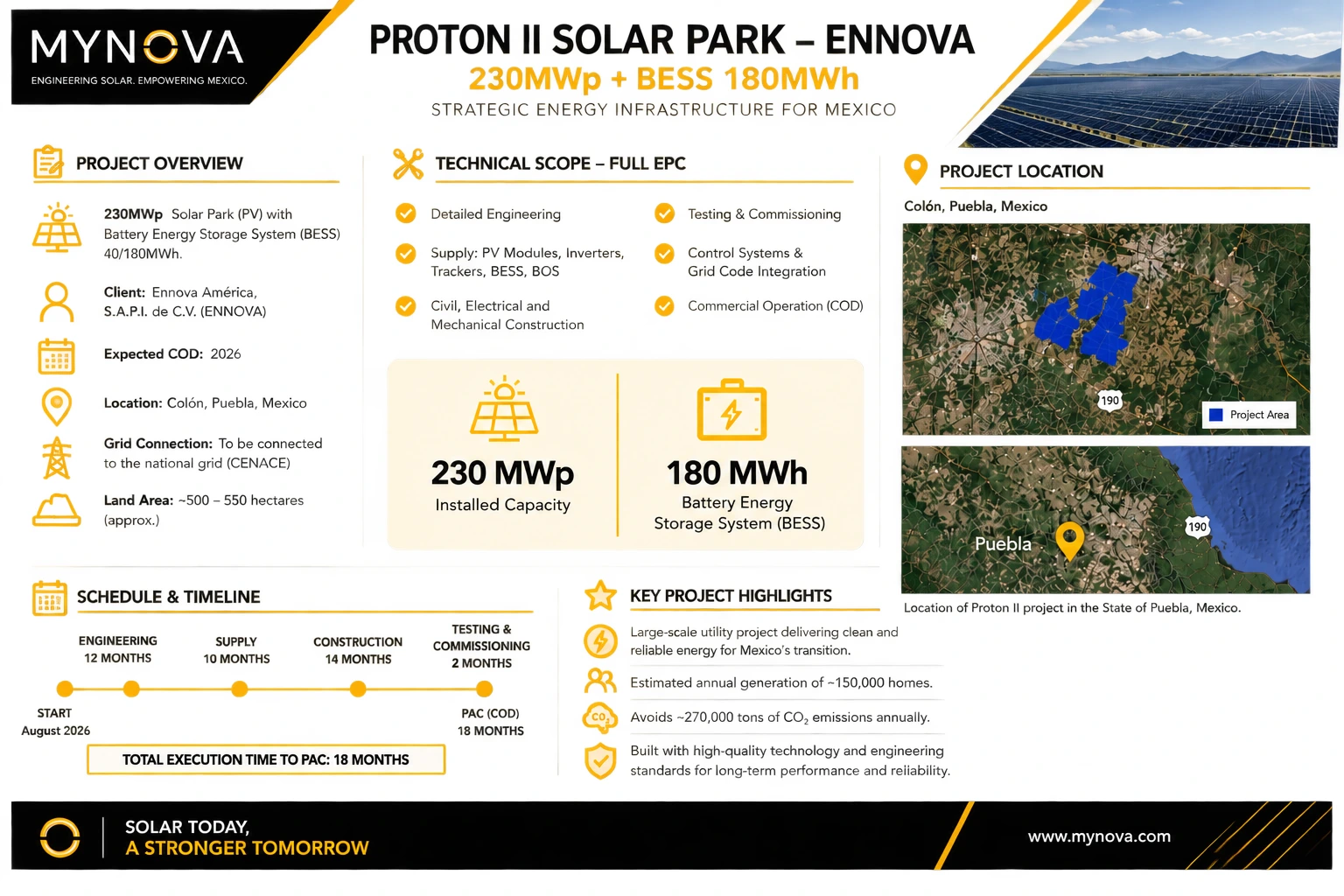
Proton II brings two parts of an energy project into one design: solar generation and battery storage. The project materials supplied to MyNova describe a solar park in Puebla, Mexico, with 230 MWp of photovoltaic capacity and 180 MWh of battery energy storage, also known as BESS.
Together, these figures outline the scale of the project. They describe different capabilities: the solar park generates electricity, while the battery system stores energy for later use.
Proton II at a glance
| Item | Information in the supplied project materials |
|---|---|
| Project | Proton II Solar Park |
| Location | Puebla, Mexico |
| Solar capacity | 230 MWp |
| Battery storage capacity | 180 MWh |
| Project approach | Solar generation combined with BESS |
| Stated delivery scope | Engineering, procurement, construction, testing and grid integration |
Project status: The figures above describe the project in the supplied presentation and brief. Current construction, grid-connection and commercial-operation milestones should be confirmed with the project team.
What do 230 MWp and 180 MWh mean?
MWp describes the rated peak capacity of the photovoltaic installation under specified test conditions. It is a measure of capacity, rather than the amount of electricity generated over a day or a year. Actual generation depends on sunlight, weather, site conditions and system performance.
MWh describes an amount of energy. For the battery system, 180 MWh identifies its stated energy storage capacity. It does not, by itself, specify how much power the battery can deliver at one time or how long it can support a particular load. Those questions also depend on the battery’s power rating, operating limits and control strategy.
Keeping these two units separate makes it easier to understand the project without confusing solar capacity with storage capacity.
Why combine solar generation with storage?
Solar production varies throughout the day. Storage adds the ability to hold energy and discharge it at another time, within the system’s technical and operating limits.
For a project such as Proton II, combining photovoltaic generation and BESS means the engineering must consider both the solar plant and the storage system, together with the controls and grid connection. The operating strategy is defined as part of the project’s engineering design.
One integrated delivery scope
The supplied project brief lists an EPC approach covering:
- Detailed engineering.
- Supply of photovoltaic modules, inverters, trackers, BESS and balance-of-system equipment.
- Civil, electrical and mechanical construction.
- Testing and commissioning.
- Control systems and grid integration.
This scope brings equipment, construction and system controls together as parts of one energy project.
Where the project fits within MyNova
The MyNova executive presentation brings together German development, Mexican execution and financing through Bankaool. Proton II appears in that presentation as a utility-scale solar-and-storage project.
The project illustrates the utility-scale side of the broader MyNova offering, alongside manufacturing, EPC services and solar solutions for businesses and homes.
Learn more about the project
View the full Proton II project overview for the supplied visual summary. For the latest project status, technical documentation or a discussion about solar and storage for your own site, contact the MyNova team.
Source: “MyNova executive ppt rev08”, slide 19, and the supplied “Proton II Solar Park – ENNOVA” project brief. This article uses the headline 230 MWp / 180 MWh figures shared by those materials.